
Local search
How one client made $850,000+ from search and AI answers in seven months
A California home services company earned $850,000+ from April to October 2026 after we tracked 300+ searches on Google and AI assistants. Here's how.

Between April and October 2026, one of our clients, a home services company in California, brought in more than $850,000 in revenue that it traces to search. Its monthly visitors are now more than five times what they were when its new website launched. Its Google clicks are more than four times its previous all-time best. And it ranks first or second on Google for its main commercial searches.
The competitors it beat for those positions were not small. By our estimates, several spend thousands of dollars a month on SEO, AI search work and Google Ads. Our client's budget was a fraction of that. The client asked us not to publish its name, so this article shows the method and the numbers without the business.
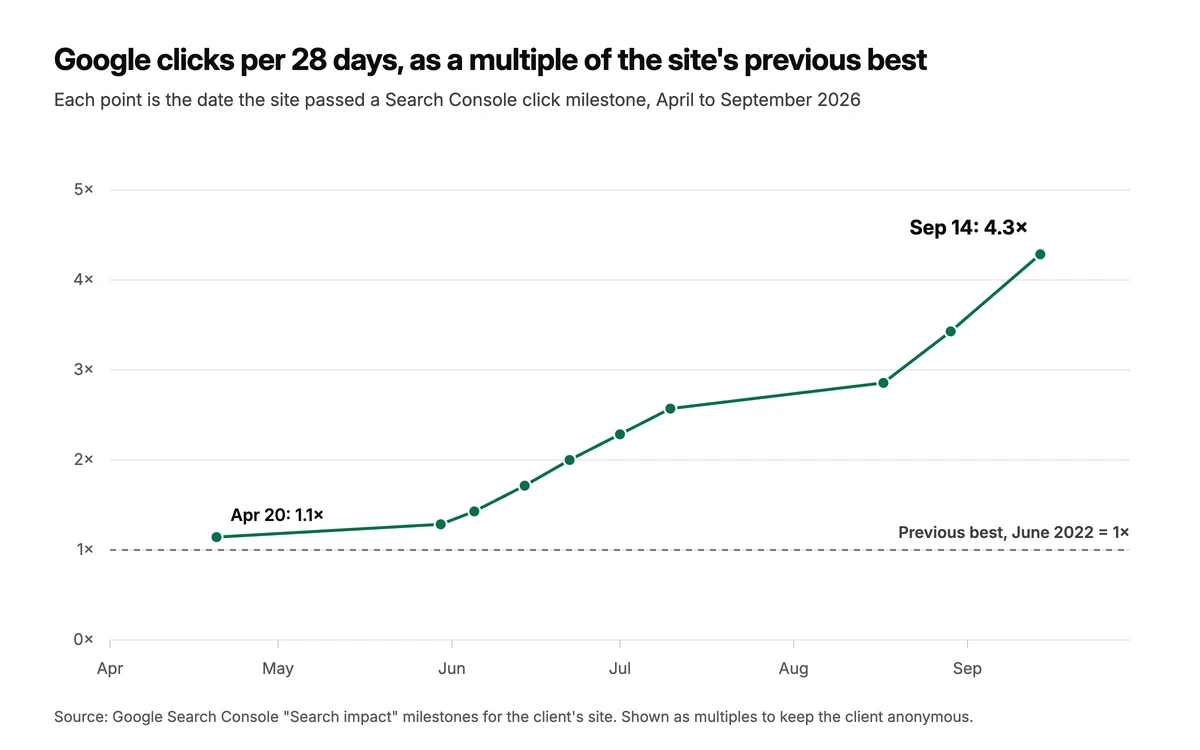
Revenue and monthly visitors reported by the client. Click milestones from the client's Google Search Console, supplied November 1, 2026, and shown as multiples so the client can't be identified.
If you compete against businesses with bigger budgets and assume search is theirs to win, this is for you. The short version: we stopped guessing which searches mattered, measured more than 300 of them every month on Google and the AI assistants buyers now use, and fixed what decided who got named.
Bigger budgets, same searches
When the work started in April, the client's buyers were doing what most buyers now do. Some typed a short search into Google. Others asked ChatGPT or Gemini a full question, the kind they would ask a friend, and took the businesses the answer named.
Both routes ended with the same few competitors. Those companies paid for the ads at the top of Google and had agencies publishing for them every week. Anyone can see which businesses run Google ads in the Google Ads Transparency Center, and our client's competitors were all there.
The owner's assumption was reasonable: if they can outspend us, they will outrank us. That assumption is where most smaller businesses stop. It is also where the opening was, because a bigger budget buys more pages and more ads. It doesn't buy the right answer to the question a buyer is asking.
Why we tracked 300 questions instead of 30 keywords
A traditional SEO report tracks a few dozen keywords. That made sense when everyone typed two or three words into Google. It misses how people search now. In its guidance on performing well in Google's AI experiences, Google says people ask longer, more specific questions in AI search and follow up with more questions after the first answer.
So we built a set of more than 300 queries. It covered the short commercial searches a buyer types into Google, the longer questions they ask an assistant before they choose, and the comparison questions they ask when they are close to deciding. Every month we ran the full set on Google and on ChatGPT, Gemini, Perplexity, Microsoft Copilot and Google's AI Overviews, and recorded who ranked, who was named and which sources each answer cited.
A set that size turns "are we visible?" into a map. You can see which questions the business already wins, which ones a competitor owns, and which ones nobody answers well. The last group is usually where a smaller business can win first, because there is no budget to beat, only a better answer to write.
We aren't publishing the query list or how we choose what goes into it. It depends on the client's market, and a copied list would mislead more than it helps. Our keyword research guide covers the starting point.
You can't fix what you don't measure, and you can't measure AI answers with a keyword tracker.
The work: SEO and AEO as one job
AEO, answer engine optimization, is the work of getting a business named and cited when someone asks an AI assistant. We treat it as part of SEO. Google says there are no extra requirements to appear in AI Overviews or AI Mode beyond the fundamentals of search, and what we saw in the query set matched that. The pages that ranked on Google were mostly the pages the assistants cited.
Making sure every crawler could read the site
Google and each AI company use their own crawlers, and a site can block one without knowing. OpenAI documents the crawlers behind ChatGPT search, and Perplexity documents its own. We checked that every one of them could reach the pages that mattered. Hosting and firewall rules catch more businesses than you would think, and nothing looks wrong to a customer when they do. Our guide to checking index status in Search Console shows how to confirm Google is getting in.
A page for each thing buyers ask about
Each service the client sells, and each place it serves, got its own page, and each page answers its question in the first lines. That follows Google's guidance on helpful, people-first content, and it is also what an assistant needs to quote a business accurately. Our guide to improving answer pages covers how to write them. Where the site's structure got in the way, our web development team changed it.
The same facts everywhere the business is listed
An assistant names a business more readily when the website, directories and profiles agree on what it does and where. We aligned the client's name, services and service area across all of them, starting with its Google Business Profile.
Being cited by sources the assistants already read
The answers in our query set kept citing the same handful of directories, publications and guides. Getting the client into those sources did more than any single page. It is the same work behind a law firm's Domain Rating rising from 6 to 56 over the same months.
Measuring calls and booked work, not positions
Rankings were never the goal. We tracked the inquiries search brought in and the client tracked which became paying work, which is how the $850,000 figure exists at all. If your inquiries go into a spreadsheet nobody updates, CRM automation fixes that before any search work starts.
How the numbers moved
| Measure | Starting point | Where it got to |
|---|---|---|
| Monthly visitors | When the new website launched | More than five times higher |
| Google clicks per 28 days | The site's previous best, June 2022 | 4.3 times that best by September 14 |
| Queries tracked each month | 300+ | 300+ |
| Revenue the client traces to search | April 2026 | $850,000+ by the end of October |
The revenue and visitor figures are the client's, from its own records. The click figures come from its Google Search Console, where it passed its previous all-time best in April and crossed six more milestones between late May and early July. We report them as they were given to us and haven't adjusted for seasonality or anything else the business changed in those months.
Why a smaller budget could win
Here is our reading, and it is an interpretation, not something the data proves.
The competitors' money went mostly into ads and volume: more posts, more pages, more placements. Ads stop the day the budget stops. Volume doesn't help when the pages don't answer the question a buyer is asking. Our client's money went into answering those questions better than anyone else in its market, and into being cited by the sources the assistants trust. That work keeps paying after the invoice.
None of this means ads are a waste. We run Google Ads campaigns for clients too. Ads are just easier to outspend than answers are.
A bigger budget buys more pages. It doesn't buy the best answer.
What this case doesn't prove
This is one client in one market over seven months. The revenue figure is reported by the client, and we can't separate what search earned from everything else the business did well in that time. No agency controls what Google ranks or what an AI assistant cites, and anyone who promises either is guessing. What we can promise is the work, the monthly query report and an honest read of it.
For other examples with public numbers, see our law firm SEO case study or the Scarsdale Solicitors case study.
Run the same check on your business
You don't need 300 queries to find out where you stand. Bring ten questions your buyers ask before they choose a business like yours. On a call, we run them on Google and the main AI assistants with you watching, and show you who gets named instead of you and why.
Book a call to see your results. You can also read how our SEO services and AI search optimization work is scoped.
Questions about SEO and AEO
AEO stands for answer engine optimization. It is the work of getting a business named and cited when someone asks an AI assistant such as ChatGPT, Gemini, Perplexity or Copilot, or when Google answers a search with an AI Overview. Some people call it GEO, for generative engine optimization.
Less than most people think. The same things that help a page rank on Google help an assistant cite it: crawlers can reach it, it answers the question plainly, and other trusted sources agree with it. The difference is in measurement. You have to check what each assistant says, because a keyword tracker won't show it.
Enough to cover the short searches buyers type, the longer questions they ask an assistant, and the comparisons they make before they decide. For this client that was more than 300. A smaller business with one service in one town can start with far fewer.
It can for the searches where the better answer wins. This client ranks first or second for its main commercial searches against competitors that spend far more. A bigger budget still helps with ads, and it helps when both businesses have equally good pages.
The figures cover April to October 2026, seven months. A business in a different market, starting from a different position, will move at a different pace.
No. Nobody controls Google's rankings or what an AI assistant cites. We commit to the work, a monthly report on the same set of queries, and a plain explanation of what changed and why.
Sources
- Client revenue and monthly visitor figures, reported to Luminous. Google Search Console "Search impact" milestones for the client's site, supplied November 1, 2026, shown above as multiples of the site's previous best.
- Google Search Central, Top ways to ensure your content performs well in Google's AI experiences on Search, May 2025.
- Google Search Central, AI features and your website.
- Google Search Central, Creating helpful, reliable, people-first content.
- OpenAI, Overview of OpenAI crawlers.
- Perplexity, Perplexity crawlers.
- Google, Ads Transparency Center.